
Compare agentic ai vs generative ai. Learn how to move beyond simple content prompts and start automating complex business workflows to scale your operations.
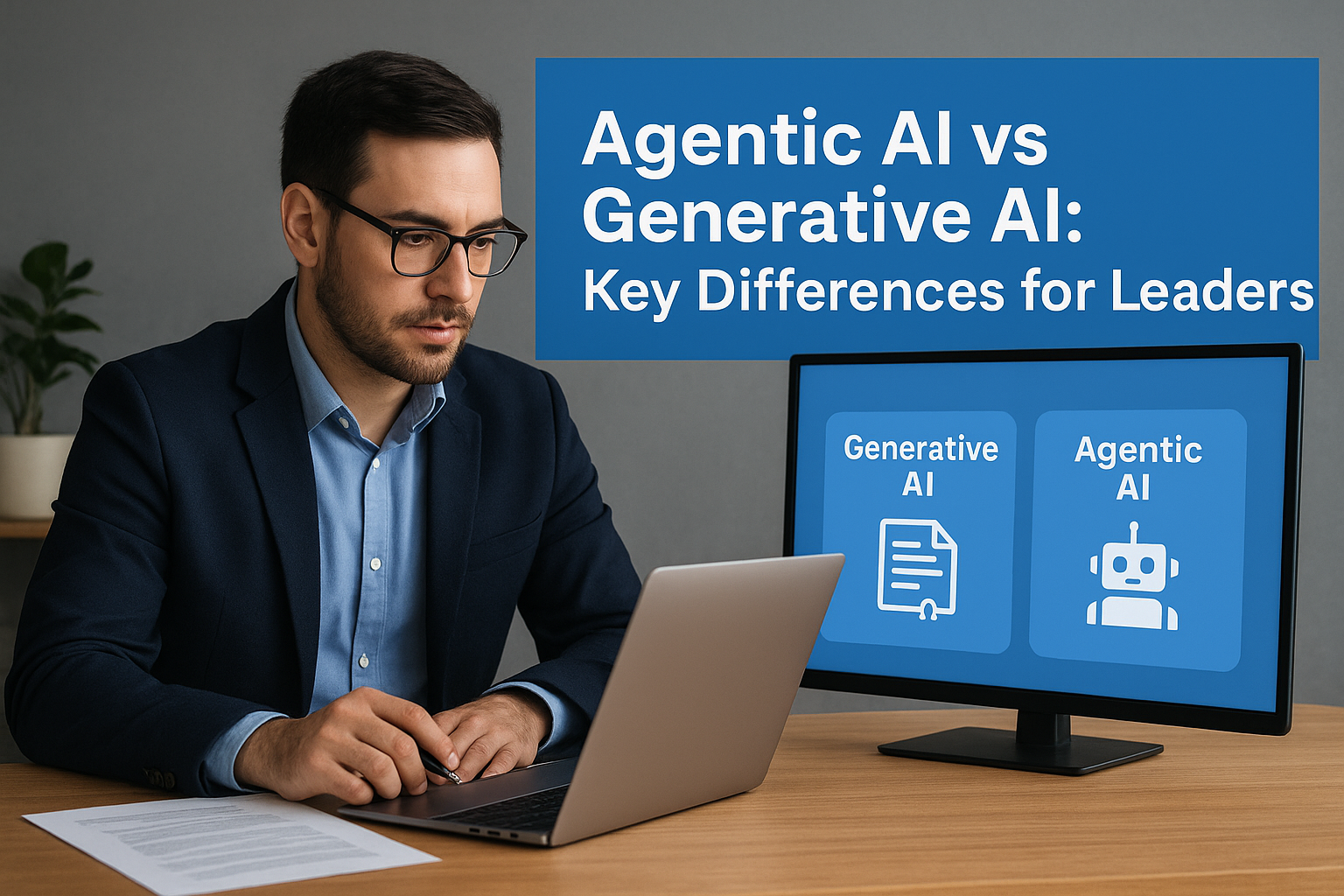
Most leadership teams have already experimented with AI that writes emails, generates images, or summarizes reports. That's generative AI, and it's useful, but it's also reactive. It only does what you ask, when you ask. The real shift happening right now is the move toward AI that acts on its own: setting goals, making decisions, and executing multi-step tasks without waiting for a prompt. Understanding agentic AI vs generative AI isn't an academic exercise. It's the difference between a tool you operate and a system that operates for you.
The confusion between these two categories is costing leaders time and money. Teams invest in generative AI expecting autonomous results, then wonder why they're still manually stitching workflows together. Meanwhile, agentic AI is already handling sales outreach sequences, triaging support tickets, and managing operational processes end-to-end, but only for companies that understand what they're actually buying. Getting this distinction right determines whether your AI investment becomes a multiplier or just another software line item.
At untaylored, we help businesses move past the hype and build AI systems that drive measurable outcomes, from custom agents to full automation workflows. This article breaks down exactly how agentic AI and generative AI differ, where each one fits in your operations, and what leaders need to know to make the right call. No jargon walls, no theoretical hand-waving, just a clear framework you can act on this quarter.
Generative AI creates content. You give it a prompt, it produces an output, and the interaction ends. That output can be text, code, images, audio, or synthesized data, but the core mechanic is always the same: input in, output out. The model draws on patterns learned from massive training datasets and generates a response that statistically fits your request. It does not remember your previous session unless you build that memory in explicitly, it does not take actions in external systems on its own, and it does not pursue goals. It is, at its core, a very sophisticated autocomplete engine.
The engine behind generative AI is typically a large language model (LLM) or a diffusion model, depending on the output type. When you ask it to write a product description, it predicts the most contextually appropriate sequence of words based on your prompt and its training. When you ask it to generate an image, it maps your text description onto visual patterns it learned during training. Microsoft's Azure OpenAI documentation describes this process as probabilistic token prediction: the model assigns probabilities to possible next outputs and selects accordingly. This means the model is not reasoning through your request the way a human would. It is matching patterns at enormous scale and speed.
The quality of generative AI output is almost entirely determined by the quality of your prompt and the relevance of the model's training data.
This matters for how you deploy it. Generative AI works best on well-defined, bounded tasks where the goal is to produce a draft, a variation, a summary, or a translation. When you hand it a clear scope, it delivers fast, usable output. When you ask it to handle open-ended decision chains, it quickly hits a ceiling.
The practical use cases for generative AI cluster around content production and knowledge acceleration. Marketing teams use it to draft campaign copy, social posts, and email sequences. Product teams use it to generate documentation and user stories. Developers use it to write and review code. Legal and finance teams use it to summarize long documents and flag key clauses. In each of these cases, a human still directs the task, reviews the output, and decides what to do with it.
This is not a weakness; it is a design reality. When you understand agentic AI vs generative AI, the comparison is not about which one is better. It is about which one fits the task. Generative AI is a force multiplier for knowledge work. It removes the blank-page problem, compresses research time, and scales output without scaling headcount. Teams that use it well save hours every week on repeatable writing and analysis tasks.
Where generative AI breaks down is in anything that requires sustained execution across multiple steps. It cannot log into your CRM, pull last week's leads, score them, send a follow-up, and then update the contact record, at least not without an orchestration layer wrapped around it. Each prompt is a one-shot transaction. The model finishes its response and waits. If your workflow requires a chain of decisions, tool use, and adaptive responses, you have moved beyond what generative AI handles natively.
Agentic AI pursues a defined goal by planning a sequence of steps, executing actions, evaluating results, and adjusting its approach based on what actually happens. Where generative AI finishes its job when it produces output, an agent finishes its job when the goal is achieved. That distinction is what makes agentic AI vs generative AI such a meaningful comparison for leaders making operational decisions right now.
An agentic system breaks a high-level objective into sub-tasks and works through them in sequence. Give an agent the goal of qualifying inbound leads from the past 48 hours, and it retrieves those leads from your CRM, scores each one against your ideal customer profile, sends a personalized first-touch email to the qualified contacts, and updates the records, all without a human prompt at each step. The agent decides the sequence, handles the tool calls, and loops back if an action fails or returns unexpected output.

Agentic AI does not wait for instructions after each step. It keeps moving until the goal is met or it hits a defined stopping condition.
This behavior runs on three components working together: an LLM acting as the reasoning core, a set of tools that let the agent interact with external systems like APIs, databases, and browsers, and a memory layer that tracks what has already happened in the current run. Microsoft's research on multi-agent systems describes this architecture as a loop of planning, acting, observing, and revising until the objective is satisfied.
Traditional automation follows a fixed script. An agentic system adapts. If an email bounces, a standard automation stops or flags an error and waits. An agent evaluates the situation and tries an alternative, such as routing to a different contact or switching the outreach channel. This adaptability is what allows agents to handle complex, variable workflows that rule-based systems cannot manage without constant human intervention. You get a system that handles exceptions on its own rather than creating a queue of manual cleanup tasks for your team.
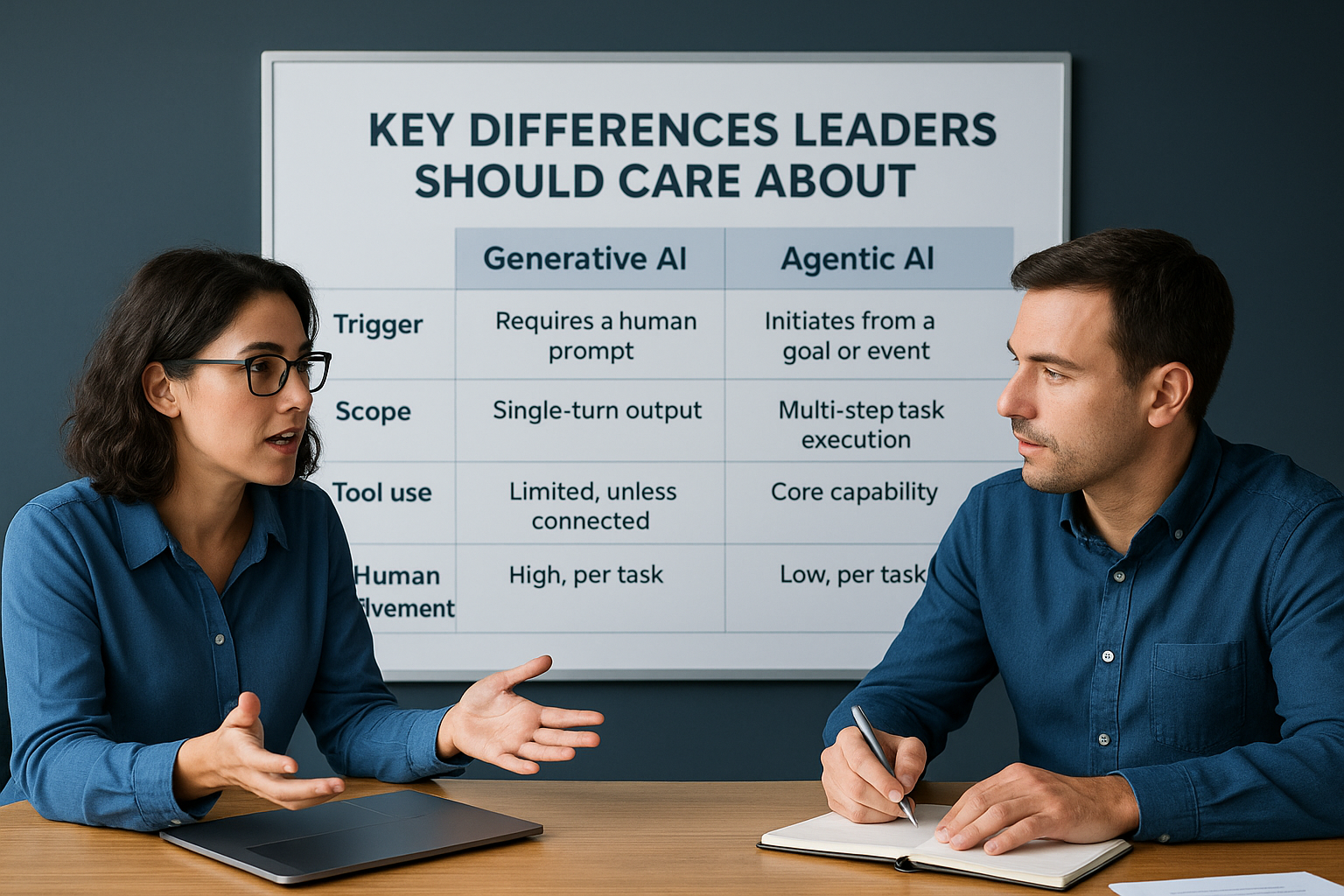
The agentic AI vs generative AI distinction comes down to one core question: does the AI wait for you, or does it move without you? Understanding this changes how you budget, staff, and govern your AI programs. The table below maps the operational differences that matter most when you are making deployment decisions.
| Dimension | Generative AI | Agentic AI |
|---|---|---|
| Trigger | Requires a human prompt | Initiates from a goal or event |
| Scope | Single-turn output | Multi-step task execution |
| Tool use | Limited, unless connected | Core capability |
| Human involvement | High, per task | Low, per task |
| Best for | Content, drafts, analysis | Workflows, processes, outcomes |
Generative AI keeps a human in the loop by design. You write the prompt, you evaluate the output, and you decide what happens next. That control is valuable when stakes are high and output requires your judgment. Agentic AI shifts that dynamic: you define the goal and the guardrails upfront, and the system executes independently. Your role moves from operator to supervisor, which requires a different kind of trust and a more deliberate setup process before you go live.
The more autonomy you grant an AI system, the more precisely you need to define what success looks like before it starts.
Unlike generative AI, which makes individual knowledge workers faster, agents make entire workflows faster. A generative tool helps one person write better content in less time. An agent handles a complete process end-to-end that previously required multiple people coordinating across systems. If your goal is to compress cycle times across a department or free up your team from repetitive coordination work, agentic AI is the right lever.
With generative AI, output gets reviewed before it affects anything downstream. Agents take live actions in real systems, which means errors propagate further and faster. You need clear boundaries, logging, and defined escalation paths before you deploy an agent into any process that touches customers, finances, or compliance. Higher autonomy demands tighter governance, not less, so build your oversight framework before you build the agent.
Seeing agentic AI vs generative AI applied to real business functions makes the distinction concrete and actionable. Both technologies are delivering measurable results today, but in very different parts of the operation. Knowing which one fits your situation prevents misaligned expectations and wasted investment when you move from planning to deployment.
Marketing and content teams see the clearest immediate gains. Production time on blogs, ad copy, email campaigns, and product descriptions drops by 60 to 80 percent in most implementations. Sales teams use it to draft personalized outreach templates and generate call prep briefs pulled directly from CRM data. HR and legal teams use it to summarize long documents, draft policy updates, and produce first-pass responses to standard internal questions.
These use cases follow a consistent pattern: a skilled person still reviews and approves the output before it reaches a customer or enters a system of record. The AI compresses the creation work, but human judgment stays in the decision seat throughout the process.
Agentic AI proves its value in workflows that cross multiple systems and require sequential decisions without a human prompt at each step. A sales agent can monitor inbound leads, score them against your ideal customer profile, trigger personalized outreach sequences, and update your CRM without a human touching each handoff. A customer support agent can triage incoming tickets, resolve standard requests automatically, and escalate complex cases to the right team member with full context already attached.
Agentic AI is not replacing your team. It is handling the coordination work that currently burns hours every week across your people.
Operations teams use agents to monitor data pipelines, flag anomalies, and initiate corrective actions before a human would catch the problem. Finance teams deploy agents to process invoices, cross-reference purchase orders, and route exceptions for approval. The business impact goes beyond speed: consistent, end-to-end execution without the coordination overhead that drains your managers' focus every single day.
The agentic AI vs generative AI decision does not start with technology research. It starts with a clear-eyed look at the specific problem you are trying to solve. Before you evaluate platforms or build a business case, map the task: is it bounded and output-focused, or does it span multiple systems and require sequential decisions? That single question will point you toward the right category faster than any vendor comparison.
If your team needs to produce more content faster, generative AI solves that problem directly. Pick a model suited to your domain, build a prompt library your team can use consistently, and integrate it into the tools your people already work in. Most teams see meaningful productivity gains within two to four weeks of structured adoption. The barrier to entry is low, and the feedback loop is short because humans review every output before it goes anywhere.
When the problem is a repeatable workflow that crosses systems and requires handoffs, an agentic approach is the right call. Start with one process that is high volume, low variance, and currently draining your team's time. Define the goal state, map every step the agent needs to take, and identify every tool it will need to access. Scope tightly on the first deployment. A focused agent that executes one workflow reliably delivers more value than a broad agent that handles many tasks inconsistently.
Deploying an agent without defined boundaries creates operational risk. Before you push any agent into production, document what actions it is allowed to take, which systems it can write to, and what conditions trigger a human escalation. Set up logging so you can audit every action the agent takes. Microsoft's guidance on responsible AI outlines a framework for human oversight that applies directly to this step.
The governance work you do before launch determines how much you can trust the system after it goes live.
Test in a sandboxed environment first, run the agent against real scenarios with monitored outputs, and expand its scope only after it has proven consistent across edge cases.
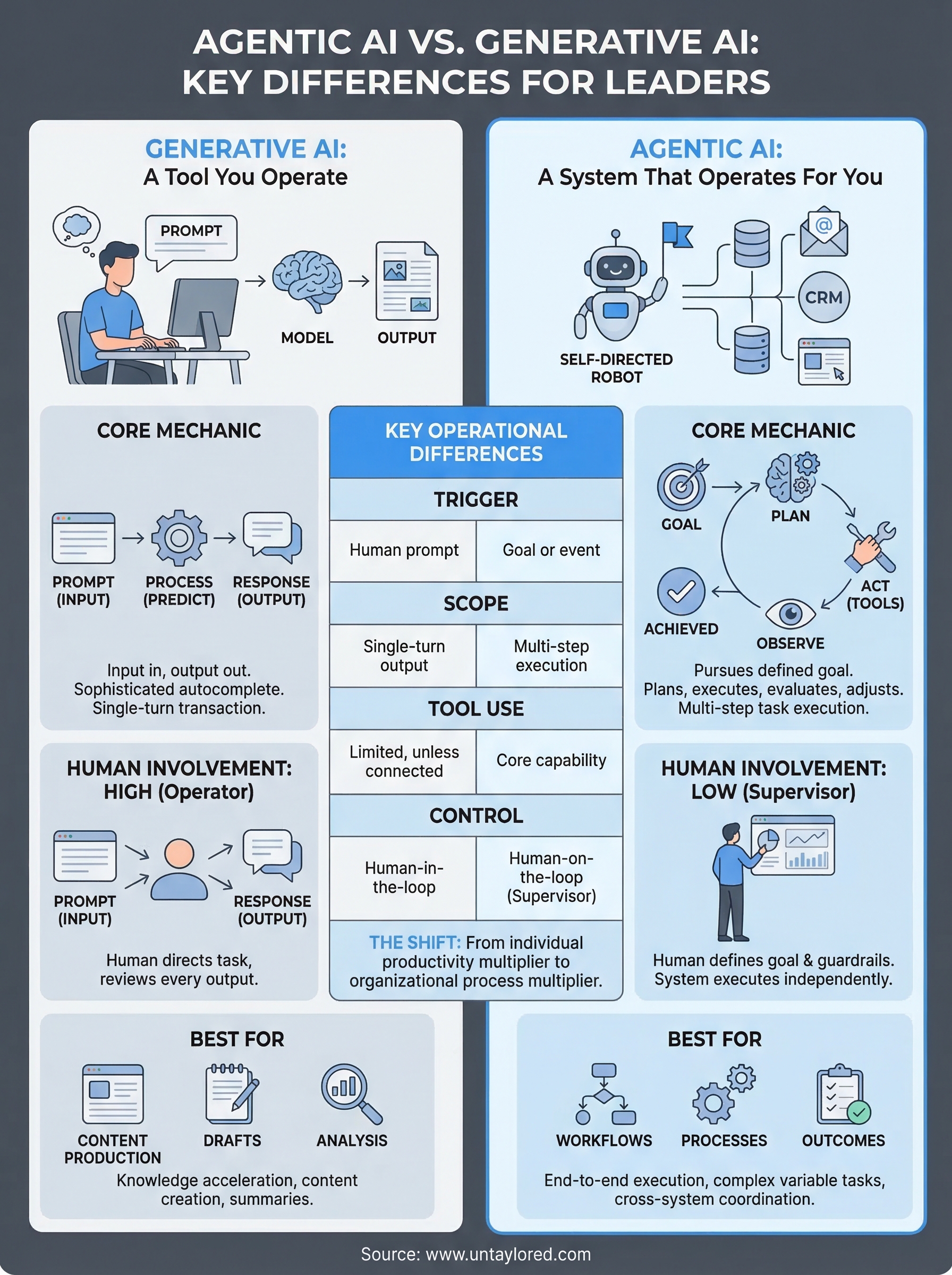
The agentic AI vs generative AI distinction gives you a practical lens for evaluating every AI opportunity on your roadmap. You now know that generative AI accelerates content production and knowledge work, while agentic AI handles end-to-end workflows that span systems and decisions. That clarity alone saves you from misaligned investments and underdelivered projects.
Your next move is to pick one process and one outcome. Start with generative AI if your team needs faster content or document output. Move to agentic AI when you have a repeatable workflow draining coordination hours every week. Either way, the results compound quickly when you build on the right foundation from the start.
If you want a structured approach to identifying where AI can deliver the most impact in your business, explore the AI transformation services at untaylored and build a roadmap that moves from diagnostic to working systems in a matter of weeks, not months.


