
Design

Learn how ai automation consulting services identify high-impact workflows and drive ROI. We cover what’s included, how to measure payback, and how to start.

Most companies know AI can help them. Fewer know where to start, what to build, or how to make it stick. That gap between "we should use AI" and actually generating results from it is exactly where ai automation consulting services come in. These services combine strategic planning with technical execution to help businesses automate workflows, reduce costs, and scale operations without burning months on trial and error.
But the term gets thrown around loosely. Some firms offer strategy decks that collect dust. Others build tools with no business logic behind them. The real value shows up when strategy and implementation work together, when someone maps out where AI fits your business and builds the thing. That's the model we follow at untaylored, where we take companies from initial AI audit to working prototype in as little as two weeks.
This article breaks down what AI automation consulting services actually include, who they're built for, and how to evaluate whether the ROI justifies the investment. No hype, just a clear, practical breakdown so you can decide if it's the right move for your business and where to focus first.
AI automation consulting services cover more than just software recommendations. At their core, these services help you identify which parts of your business can run faster or cheaper with AI, then design and build the systems to make that happen. The scope typically spans strategic diagnosis, workflow redesign, and hands-on technical execution, often delivered by the same team rather than split across multiple vendors.
Every solid engagement starts with a clear picture of where you are. A consultant will map your existing workflows, identify bottlenecks, and rank automation opportunities by potential impact. This phase usually produces an AI audit or roadmap that tells you which processes to tackle first and why, based not on what's trendy but on what will actually move the numbers that matter to your business.
Skipping the strategy phase is one of the most common reasons automation projects stall, because you end up building tools that solve the wrong problems.
The output is not a generic report. It's a prioritized action plan tied to your specific revenue model and team structure, and it provides clear sequencing so you're not guessing when it's time to build.
Once you know what to build, the work shifts to execution. This is where consultants design and deploy actual AI systems, whether that's a voice agent that handles inbound calls, a chatbot that qualifies leads, or an automated pipeline that processes data without manual input. The best firms prototype quickly, test against real business conditions, and iterate before full deployment.
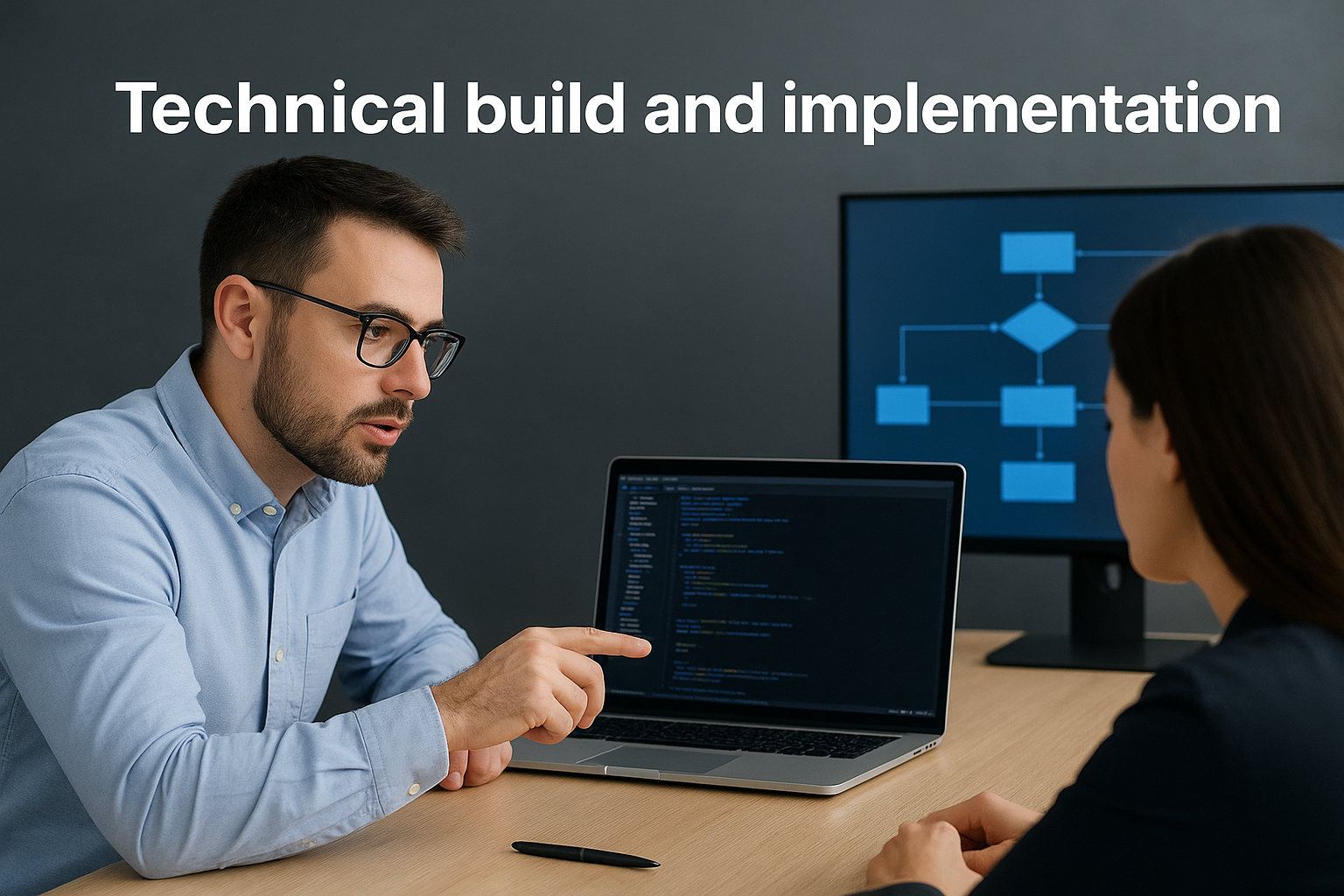
Your new tools also need to connect to the software you already use. Integration support, documentation, and testing are part of a thorough implementation, and handoff training ensures your team can run the systems independently after the engagement ends.
Most businesses don't lack the motivation to adopt AI. They lack the time, internal expertise, and a clear starting point to do it well. Hiring a consultant removes the guesswork and shortens the path from identifying an opportunity to seeing it actually work in production.
Building AI systems requires a specific mix of skills that few internal teams carry all at once. Assigning automation projects to teams that already have full workloads rarely produces results, and hiring full-time specialists for a project-based need rarely makes financial sense. A consultant brings the full stack without the overhead.
The fastest way to stall an AI initiative is to treat it as a side project for your existing staff.
The core skill areas a good consultant covers include:
When you engage ai automation consulting services, you get a structured process rather than a learning curve. Consultants have already worked through the common failure points on other engagements, which means your project moves faster and avoids costly detours.
Your investment also carries lower execution risk because the methodology is proven, not experimental.
Most ai automation consulting services follow a structured sequence. Understanding the typical phases helps you set realistic expectations before you commit.
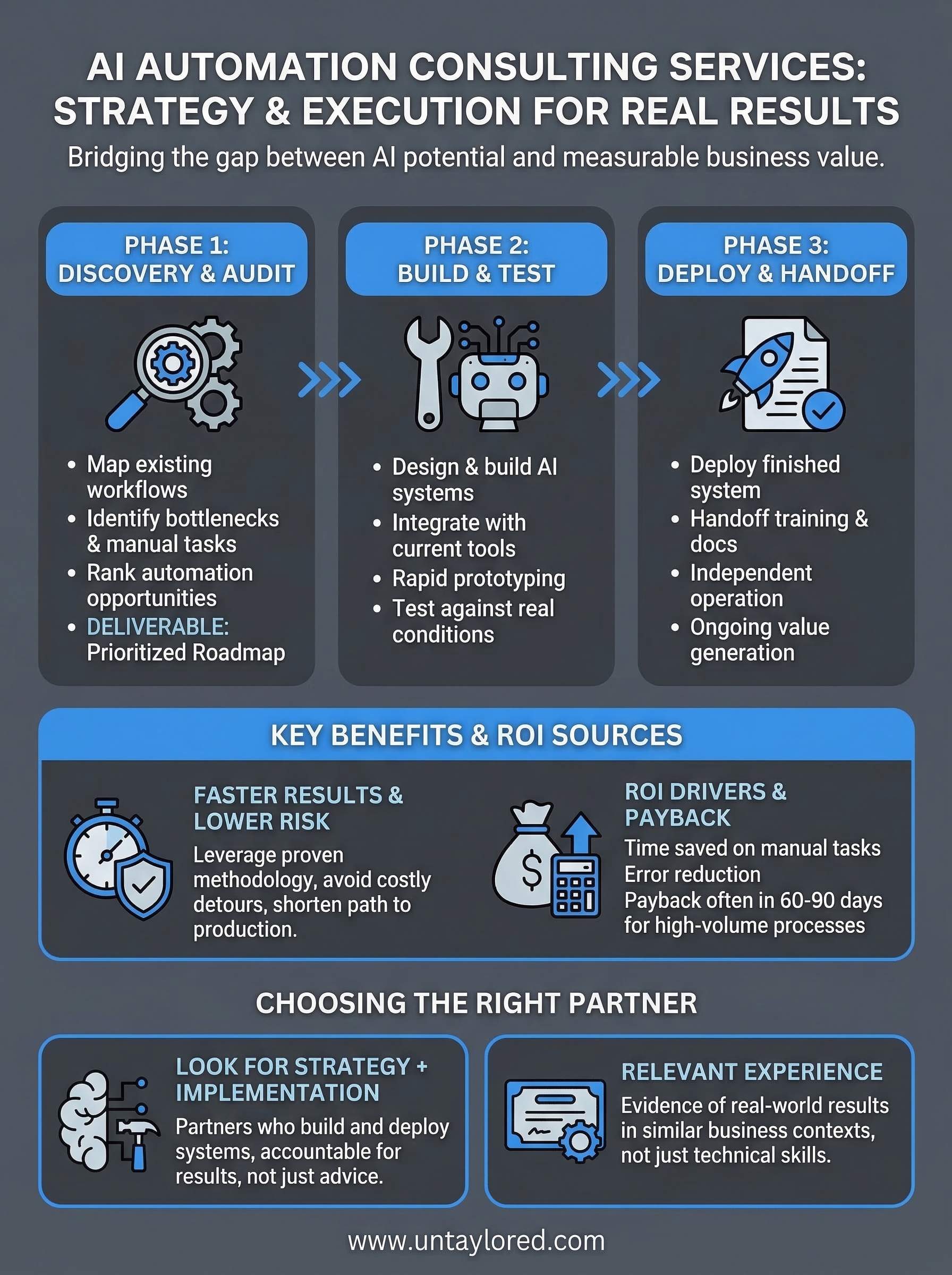
The engagement starts with a detailed review of your current operations. Your consultant maps workflows, identifies bottlenecks, and ranks automation opportunities by business impact. The deliverable is a prioritized roadmap, not a generic report.
A strong discovery phase answers one question: which process, if automated first, produces the fastest measurable return?
This audit typically covers:
With a clear target, the team designs and builds your first automation, integrating it with your existing tools. Testing happens against real business conditions before anything goes live, and iterations happen fast.
Speed matters more than perfection at this stage. A working prototype that you can test and refine is worth more than a polished spec sitting in a document.
Your consultant deploys the finished system and transfers ownership through documentation and light training. A defined support period follows so your staff can operate the tools independently after the engagement closes.
Ownership transfer is deliberate. Your team needs to maintain and adapt the system without re-engaging the consultant for routine changes, so the handoff includes clear guidance on what to do when things need adjusting.
Before you commit to ai automation consulting services, you need a realistic view of what returns to expect and when you'll see them. Most automation ROI comes from two sources: time saved on manual tasks and error reduction that prevents downstream costs.

Start by measuring what a process costs you today. Count the hours spent, the people involved, and the error rate for the workflow you plan to automate. Multiply those hours by your fully loaded labor cost to get a monthly baseline.
If you can't measure the current cost of a process, you can't measure what you saved by automating it.
Three variables determine how fast you recover your investment: the volume of the process, the frequency it runs, and how much human time it currently consumes. High-volume, repetitive tasks pay back fastest, often within 60 to 90 days.
Your consulting fees and build costs sit on one side of the equation. Ongoing savings from reduced labor, faster output, and fewer errors sit on the other. Once monthly savings exceed monthly costs, you've hit payback. From that point forward, every month the system runs generates net return.
Not every firm that offers ai automation consulting services delivers the same value. Some consultants produce strategy documents and walk away. Others build tools with no commercial logic behind them. The right partner does both: they understand your business model and they can execute against it.
Ask any prospective consultant directly: do they build and deploy the systems, or do they hand off a plan for your team to execute? If the answer is the latter, you carry most of the risk. Firms that stay through deployment are accountable for results in a way that advice-only consultants are not.
The clearest signal of a strong consulting partner is a structured engagement model with defined deliverables at each phase, not an open-ended retainer.
Look for evidence of real-world results in business contexts similar to yours, not just technical credentials or case study buzzwords. A consultant with deep knowledge of your industry's workflows will identify better automation targets faster and with fewer false starts. Ask for specific examples of previous builds, the problems they solved, and how long the payback period was.
You now have a clear picture of what ai automation consulting services involve and what realistic returns look like. The next step is straightforward: identify one high-volume, repetitive process in your business that costs your team significant time each week, and treat that as your starting point. A single well-chosen automation can produce measurable payback within 90 days and build the internal confidence to keep going.
Most companies that delay do so because the full scope feels overwhelming. It doesn't need to be. Starting narrow, proving the value, and expanding from there is a more reliable path than trying to transform every department at once. A structured partner handles the complexity so your team can stay focused on the work that actually needs human judgment.
If you're ready to move from "we should use AI" to a working system, explore how untaylored approaches AI-driven business transformation and see where the right starting point might be for your business.


