Business Model Innovation

Discover how AI uncovers hidden market opportunities with a proven workflow to prioritize and validate your next growth move.
You’re sitting on a mountain of data—customer feedback, market reports, web analytics, social media chatter. You know the next big growth opportunity is buried in there somewhere, but the sheer volume is overwhelming. Traditional analysis feels like searching for a needle in a haystack, while your competitors seem to be one step ahead. How do you move from reacting to market shifts to proactively creating them?
This isn't a data problem; it's a discovery problem. The challenge for modern leaders isn't a lack of information but a lack of clarity. The real question is: how can you systematically identify and validate new market opportunities with confidence, before they become common knowledge?
This is where AI transforms the game. Not as a black box that spits out random ideas, but as a powerful lens that helps you see patterns, predict trends, and spot untapped customer needs with incredible precision. It’s about building a repeatable engine for growth, one that turns market uncertainty into your greatest competitive advantage.
For decades, market discovery has relied on a combination of intuition, manual research, and historical data. This approach is slow, biased, and often misses the subtle signals that precede a major trend. AI-driven discovery flips the model from reactive to predictive.
By leveraging machine learning algorithms, businesses can now:
The goal isn't just to find an opportunity; it's to find the right opportunity for your business—one that aligns with your strengths and offers a clear path to revenue. This requires a structured approach that combines the power of AI with strategic business acumen.
Simply pointing an AI tool at your data and hoping for a breakthrough isn't a strategy. The most successful organizations use a deliberate, multi-step process to move from broad exploration to a validated action plan. This methodology ensures you’re not just chasing noise but are building a strong foundation for your next venture.
Our approach centers on a clear, five-step workflow designed to de-risk the discovery process and build momentum. A critical part of this is acknowledging that real-world data is never perfect. For instance, you might encounter technical issues like API failures that prevent you from gathering key competitive data, such as SERP intelligence. A robust process doesn't fall apart when this happens; it flags the gap and adapts.
Here’s how this structured workflow unfolds:
This methodical process, central to our AI Strategy & Roadmap service, transforms the fuzzy front end of innovation into a predictable and reliable engine for growth.
An AI-powered ideation phase can generate dozens, if not hundreds, of potential opportunities. This is both a blessing and a curse. Without a rigorous system for prioritization, teams can quickly fall into analysis paralysis or chase opportunities that don’t align with their core business.
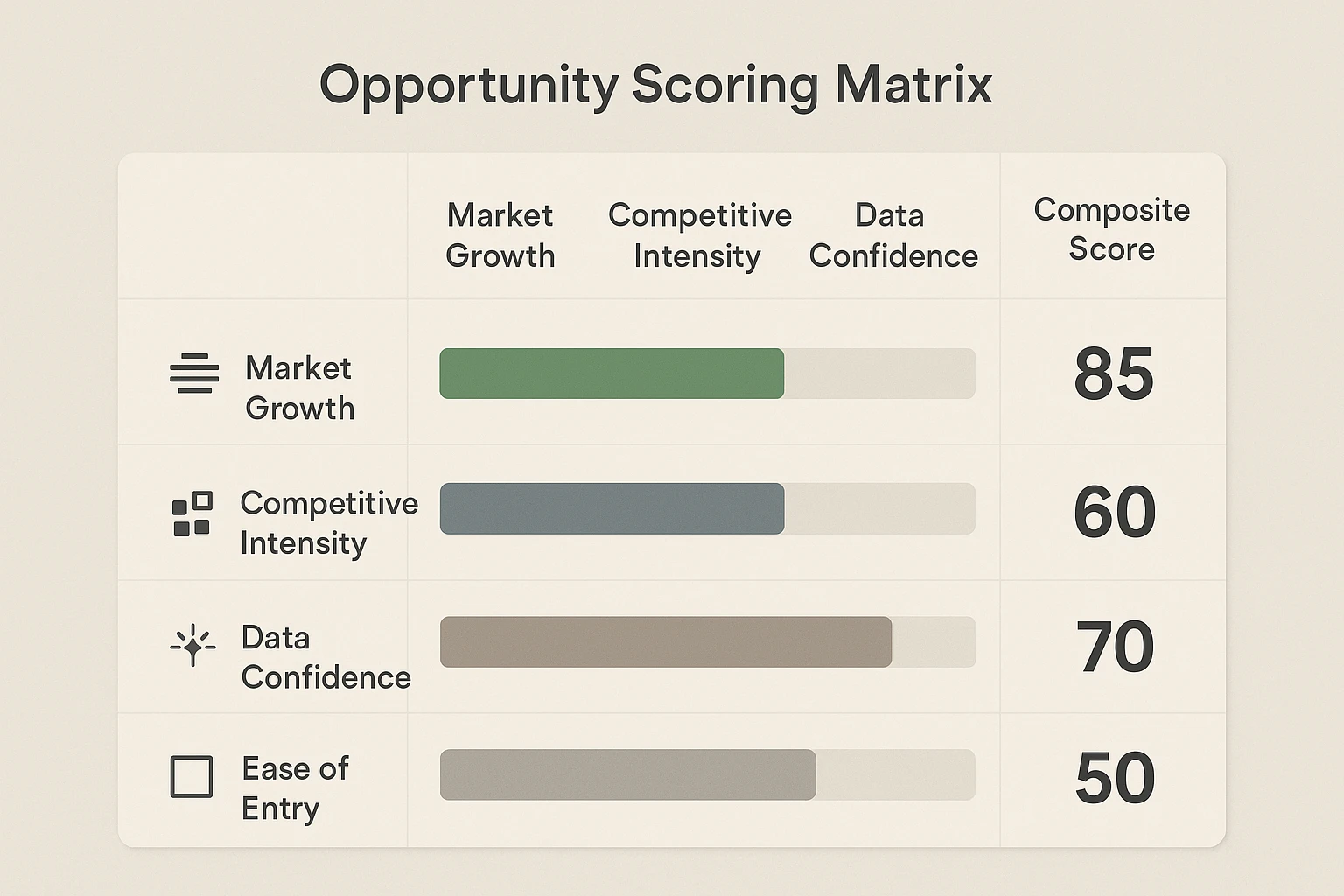
To solve this, we use a scoring matrix that evaluates each potential market segment against a consistent set of business-critical criteria. This transforms a subjective debate into an objective, data-driven decision. The framework forces you to consider not just the potential upside but also the practical realities of execution.
Key evaluation criteria typically include:
By scoring each opportunity across these vectors, you create a visual heatmap that immediately highlights the most promising initiatives—those with high potential and a clear path to execution.
After prioritizing your top opportunity, the final step is to build a compelling business case and make a confident go/no-go decision. This involves synthesizing all your findings into a concise, executive-level summary that quantifies the potential impact and acknowledges any remaining risks.
A decision card is an invaluable tool for this stage. It distills complex analysis into the essential information needed to secure buy-in and commit resources. It’s the final piece of the puzzle that connects your AI-driven discovery to tangible business action.
This summary serves as a final gut check. Does the opportunity feel right? Is the potential reward worth the calculated risk? By framing the decision in this way, you ensure that your investment in a new market is not a leap of faith, but a strategic move backed by a clear-eyed analysis of the facts.
You can start with what you have. The process is effective with a mix of internal data (CRM, sales records, support tickets) and publicly available data (industry reports, social media, review sites). The key is to start with a clear business question, and the framework will help identify and even fill data gaps along the way.
Not at all. The value of a structured approach like our proven 3-step game plan is its efficiency. It's designed to move from ambiguity to clarity quickly, focusing on "quick-win" solutions that build momentum. A typical discovery sprint can generate actionable insights within weeks, not months.
AI is the discovery engine, but human expertise provides the strategic filter. The prioritization and validation steps are designed to ensure that every recommendation is vetted against your company's unique strengths, resources, and strategic goals. We never recommend an opportunity that isn't a strong strategic fit.
The ROI comes from several areas: accelerating time-to-market for new products, increasing the success rate of new ventures, identifying cost-saving operational improvements, and uncovering new revenue streams. By de-risking innovation, the process prevents costly investments in ideas that lack market validation.
In today's fast-moving market, waiting for opportunities to present themselves is no longer a viable strategy. The companies that will lead the next decade are those that build a systematic capability for seeing around the corner—for finding and validating new sources of value before they become obvious.
AI provides the tools, but a structured methodology provides the map. By combining powerful technology with a rigorous strategic framework, you can turn the overwhelming noise of the market into a clear signal, guiding you directly to your next big win.
If you're ready to move from guesswork to a proven system for discovering and launching your next growth engine, let's talk about how our AI Business Applications can build a custom roadmap for your success.